Tuesday, 15 February 2011

We Want More Say in This Union, Zanzibar Tells Tanzania Govt


NairobiThe course of the 47-year existence of the United Republic of Tanzania has been anything but smooth.

From Zanzibar nationalism, the structure of government, and inequity in the sharing of government offices within the Union to sharing the benefits and costs including revenue and foreign aid, the problems have kept coming back to haunt the Union government.

According to a report of the Kituo Cha Katiba fact-finding mission to Tanzania, with regard to the economy, Zanzibar argues that there are unfair fiscal and monetary agreements that kill its economy.

For example, it points out that there is double taxation of goods imported into the Tanzania Mainland from Zanzibar.

Petroleum and natural gas, which are likely to be discovered off the islands, have been included in the list of Union matters.

However, gold, diamonds and tanzanite that are found in Tanzania Mainland are not classified as such.

Even more contentious is the list of matters reserved for the Union government.

The original 11 articles were, over time, increased, reaching 22 by 1990. To Zanzibaris, this is intended to undermine the autonomy and identity of Zanzibar.

Zanzibar complained about the sharing formula of revenues of 4.5 per cent for Zanzibar, which the Isles suggest be raised to 10 per cent.

The Union insists that is too high and would settle for 5 per cent.

Likewise, complaints persist that the Union government exclusively bears all costs of collecting revenue in Zanzibar (by the Tanzania Revenue Authority).

"In terms of resources, the people in Zanzibar pointed out that the mainland has minerals, national parks, agricultural land as compared with Zanzibar, which has limited resources..." says the report.

With regard to foreign aid they pointed out that although it is solicited and received in the name of the United Republic, Zanzibar receives little, or nothing in respect to non-Union matters such as agriculture.

It is the mainland that decides on behalf of Zanzibar how much it should get. Yet Zanzibar cannot shop for foreign aid for itself.

On their part, business people decried double taxation, saying that while the TRA has a presence in Zanzibar, once you re-export to the mainland, there is reassessment, harassment, delays in clearing the goods.

The structure of government has also been put under a microscope.

The bone of contention is that the Union deals with Union and non-Union matters lumped together.

Hence Zanzibaris feel that when a minister of the Union deals with issues affecting both entities, he is likely to favour the mainland. In short, there is a conflict of interest.

At the same time, budgetary allocations are bundled together for the Union government and Tanzania Mainland without any clear distinction.

It is for this reason that there has been a clamour for the establishment of a three-tier government consisting of the Union, Zanzibar and Tanzania Mainland.

This problem dramatically took centre stage in 1984 and led to the then president of Zanzibar, Aboud Jumbe, being forced to resign.

In regard to political and government institutions and processes, Zanzibaris stated that they are not considered a country, yet they are.

They pointed out that while the Union entails two countries, their president has no role.

They pointed to the inequity in the sharing of government offices within the Union. There are only three ambassadors from Zanzibar.

The ambassadors from the mainland work for the benefit of the mainland. Likewise, they point to the relatively few Zanzibaris serving in embassies abroad.

A Zanzibari is yet to serve as the Inspector General of Government.

n the army, all ranking generals are from the mainland. Most staff in the Tanzania Revenue Authority are said to be from the mainland too.

"In general, therefore, at the political level, many Zanzibaris do not think the Union is in their interest; they think that they have no say in the Union. They feel marginalised; they believe that, at the institutional level, they are not taken care of. They do not get to learn of opportunities or services offered by ministries dealing with Union matters since they do not maintain offices in Zanzibar," the mission observes in a report titled "Federation within Federation: The Tanzania Union Experience and the East African Integration Process."However, peace and security were pointed out as benefits of the Union.

From the mainland, there were complaints about the over-representation of Zanzibar in Union institutions, including parliament.

It was also pointed out that the portfolios for the mainland in government are virtually non-existent since there are people from Zanzibar holding portfolios for non-Union matters.

According to the mission, these issues were compounded by the unique structure of the Union: A two-government structure with a Union government and government of Zanzibar, but without a Tanganyika government. On the one hand, it was claimed that Zanzibar could not negotiate with the partner with whom they had executed the Union treaty with a view to modifying it as the need arose.

Revive Tanganyika

On the other, there were voices from the mainland calling for the revival of a Tanganyika government.

The dual mandate of the Union government, for instance, jurisdiction over Union matters, and over non-Union matters of the mainland created its own problems and suspicions.

"An attempt was made to design mechanisms to deal with the problems but these, including the Constitution Court, a Permanent Commission and many ad hoc ones appear to have been largely ineffectual; they always had to resort to the one-party structure to deal with the issues," the report observes.

"The transition to multiparty politics has made the latter approach to Union problems impractical. The transition has also brought in its wake, problems of electoral and post-electoral violence and claims of electoral fraud in Zanzibar. This has in turn highlighted the problems of the Union, and in particular the place of Zanzibar within the Union," it adds.

The incremental erosion of the powers of the government of Zanzibar is best illustrated by the 1977 merger of Tanganyika African National Union and Afro Shirazi Party.

This meant that matters that were entirely within the jurisdiction of Zanzibar were to be decided by a pan-territorial political party - Chama cha Mapinduzi.

Renegotiation

In the political arena, two court cases were filed asking the High Court of Zanzibar to declare the Union null and void.

Other players have mooted the renegotiation of the Articles of Union to create a fully fledged federation.

The Articles of Union constitute the legal basis of the Union and for them to have effect, they should have been ratified by both Tanganyika and Zanzibar.

There is no evidence of any law in Zanzibar ratifying the treaty. The only evidence of ratification appeared in the Government of Tanganyika Gazette under the signature of the Solicitor General of the Tanganyika Government.

The Union, therefore, it is concluded by some, "lacked a legal basis right from the very beginning because while the Articles were signed by Karume they were not ratified. The Union therefore exists de facto, but not as a matter of law," the reports notes.

"Hence decisions were made on the basis of good will and political expediency rather than law and the constitution. The unification process was not constitutionalised; it was just a political agreement between Nyerere and Karume and even the Articles of Union came as an afterthought. They were formulated subsequent to the fact."

It was stated that some key figures in government do not understand the structure of the Union, for instance, the two governments and three jurisdictions.

This creates confusion which is compounded by the constitution itself.

It was pointed out that while Article 4 of the constitution does provide for the two governments with three jurisdictions other parts of the constitution mix up things and blur the distinction.

Thursday, 10 February 2011

HARUSI TRADE FAIR 2011 - MAONYESHO YA HARUSI 2011


Maonyesho ya Harusi kufanyika Dar.
Wadau wa Harusi kukutanishwa Dar
Siku tatu za Maonyesho ya Harusi Diamond Jubilee
Maandalizi ya Maonyesho ya Harusi 2011 yapamba moto Dar


Maandalizi ya maonyesho ya pili ya Harusi Tanzania ‘Harusi Trade Fair 2011’, yanayotarajiwa kuanza tarehe 1- 3 mwezi ujao katika ukumbi wa Diamond Jubilee yanaendelea vizuri , huku yakiwa yanajumuisha wataalamu waliobobea katika nyanja zote zinazohusiana na suala zima la Harusi.

Muaandaaji na msimamizi wa maonyesho haya makubwa ya Harusi Tanzania, Mustafa Hassanali amesema kuwa “maonyesho ya mwaka huu yatakuwa makubwa, mazuri na yenye kuvutia zaidi ya mwaka uliyopita, na tunatazamia kuyafanya yawe maonyesho makubwa zaidi kwa ukanda huu kwa miaka ijayo”

Nukuu zinasema kuwa, maonyesho ya mwaka huu tayari yameshawavutia zaidi ya washiriki 32 , wakiwemo washiriki wa maonyesho yaliyopita na wapya.

Maonyesho ya Harusi ya mwaka 2011, ni maonyesho ambayo uboreshaji wake umevuka kutoka siku mbili za maonyesho hadi siku tatu kwa mwaka huu, huku likiongezewa na kujumuisha vionjo vingi zaidi.

“Harusi ni tukio zuri, ambalo hutokea mara moja tu, huku likiunganisha familia na jamii pamoja, hivyo nia yetu ni kuwapa maharusi mahitaji yao yoote muhimu kwa pamoja na kwa wakati mmoja, na maonyesho haya ndio sehemu muafaka kwa hilo” alisema Mustafa Hassanali.

Maonyesho haya ya Harusi ambayo hufanyika kila mwaka, huwaleta pamoja wahusika wote wa mambo ya Harusi katika kujenga na kutengeneza mtandao wa kimafanikio baina yao, na ndio maana maonyesho haya yamekuwa ni ya kwanza na ya aina yake Tanzania, ambapo kwa mwaka huu yatapambwa na vitu kama keki, maua, wapiga picha, magauni ya Harusi, bila kusahau mengi na yenye ubunifu katika Harusi.

Gabriel Makupa wa ‘GRM Production’, ambae ni mmoja wa washiriki wa mwaka huu wa maonyesho haya alisema kuwa, wamekuwa na wakati mzuri kibiashara, hali iliyosababishwa na ushiriki wao katika maonyesho haya kwa mwaka uliyopita.

“tumekuwa na wakati mzuri kibiashara, hii imetusaidia kujenga mtandao mzuri kibiashara, tulitangaza huduma zetu vilivyo, na hii ndo sababu ya sisi kushiriki tena mwaka huu” alisema Gabriel wa GRM, kampuni inayojihusisha na upigaji picha katika maharusi.

“makampuni yajitokeze kutangaza huduma zao mwaka huu katika maonyesho haya, ni nafasi nzuri, kwani tumeshapata makampuni 32 mpaka sasa yatakayoshiriki mwaka huu, idadi ambayo inaongezeka kila siku, “ alisema Mustafa Hassanali.

Mmoja wa washiriki wa mwaka huu wa maonyesho kutoka ‘Karibu Holiday’, kampuni inayoshughulika na maandalizi ya fungate kwa maharusi na mapumziko binafsi nchini, Bw. Susai Nathan alisema kuwa, maonyesho ya mwaka huu ni njia mbadala ya kutangaza huduma zao mpya zenye ubora maalum kwa fungate, mahususi kwa maharusi au watakaofunga ndoa katika miezi hii mitatu ijayo.

Haya ni maonyesho ya siku tatu ambayo yana mengi, na si yakukosa kushiriki ama kuhudhuria kwa maharusi, familia, na wale wote wanaohusika na kamati za Harusi, ili kujionea na kujua mengi yahusuyo Harusi na mahitaji yake.


Kwa maelezo zaidi tembelea hapa

Ni wiki ya Sauti za Busara 09.02 - 13.02.2011

Wote Mnakaribishwa

Tuesday, 8 February 2011

Watanzania Wajitolea Kutahiriwa...


The Tanzanian government has embarked on a large-scale voluntary male circumcision programme aimed at reducing the HIV risk of men and boys in areas of the country with low levels of male circumcision.

"We have already completed a pilot project and we are now scaling up male circumcision," said Bennet Fimbo, HIV/AIDS adviser to the Tanzania Ministry of Health. "The target group in the campaign will be men and boys aged 10-34."

The programme aims to reach 2.8 million men and boys within the next five years.

Three randomized controlled trials in Kenya, South Africa and Uganda provided evidence that male circumcision can reduce a man's risk of becoming infected with HIV through heterosexual intercourse by as much as 60 percent. The UN World Health Organization recommends male circumcision as one of the tools for HIV prevention, alongside counselling and testing, promotion of safer sex, treatment of sexually transmitted infections and condom use.

An estimated 70 percent of Tanzanian men are circumcised, according to government surveys, but prevalence varies from region to region.

"In some districts up to 80 percent of men, especially in the western parts of the country, are not circumcised," Fimbo said. "In places like Zanzibar, Pemba and coastal areas, where the population is predominantly Muslim, the circumcision rate is almost 99 percent."

He noted that HIV prevalence tended to be lower in areas of the country where male circumcision was common. "In Zanzibar and Pemba, the prevalence is less than 1 percent, while around Lake Victoria, Mbeya and Iringa regions, circumcision is low and HIV prevalence is 14-20 percent."

The programme will focus on seven regions in western Tanzania where levels of male circumcision are particularly low: Iringa, Kagera, Mar, Mwanza, Rukwa, Shinyanga, Tabora, Rukwa.

The programme - supported by the USA - will provide the service free of charge; male circumcision usually costs US$10-17.

AN

Boris Johnson Meya wa London Mashakani Zenj...


Boris Johnson was left humiliated after he had to be rescued while swimming in the sea at a luxury resort.

The gaffe-prone Tory was taking a morning dip with wife Marina when he was swept away by powerful currents off a private island near Tanzania.

Worried staff were so concerned they sent out a boat to fetch him.
One worker, who asked not to be named, revealed: “They didn’t realise how strong the current was. They went out a bit too far and he was getting carried away so we had to launch a motor boat to get them.”

Mayor of London Boris went to the island retreat for the family holiday at the Lazy Lagoon in the Zanzibar channel last year. He was asked if he needed TV news but apparently told staff: “Just tell me if they try to blow up the Tubes again.”
When he made it ashore after being rescued, he tried to laugh off the drama, declaring: “That’s one for the memoirs.”

The mayor, 46, likes to get around by bike but a friend admitted: “He’s not the strongest swimmer.”
Boris got into trouble in the water a couple of years ago when he stumbled into a river in Lewisham, South East London, during a photo call.


Read more: http://www.mirror.co.uk/news/politics/2011/02/05/boris-johnson-rescued-by-boat-after-being-swept-away-as-he-swam-from-luxury-private-african-island-115875-22899730/#ixzz1DM7iDUEv
Go Camping for 95p! Vouchers collectable in the Daily and Sunday Mirror until 11th August . Click here for more information

Thursday, 27 January 2011

Wednesday, 26 January 2011

MMhmm!

Monday, 24 January 2011

Mv Mapinduzi


Kuna tetesi kuwa imeshapigwa bei!

Pemba...

Saturday, 22 January 2011

Zanzibar Property - Getting Your Project Built


Perhaps this is your first foreign investment overseas, or maybe it’s your first African investment and you’re wondering how the process of getting your project built, whether it’s a hotel or a supermarket.

As with all things in business, there are cheap ways to do things and expensive ways. There are plenty of local building contractors who are more than capable of turning your vision into reality but they may lack the experience of more modern building techniques and safety considerations.

Often the design is drawn by hand and discussed with the local contractor and the changes are sketched on the spot and then the build can begin. Detailed plans and blueprints are generally not required with the local way of building - you’ll find that things are done in a very ad hoc way.

Obviously this method of building requires a lot of hand holding and direction; you will need to spend a large amount of time on the building site ensuring that everything is going to plan. This method of building can be quite enjoyable for some people, but it’s definitely not for investors who want to do everything remotely.

In this instance, it is better to go with the Western approach to building. Detailed plans by a trained architect, an experienced building company with access to the latest techniques and technologies and a foreman who has experience on large projects. Companies like this do exist on the island but they charge a big premium. Often the larger investment projects will hire a contractor in their own country and then send them across to Zanzibar to manage the entire project.

Building materials in Zanzibar are generally twice the cost of mainland Tanzania due to high import taxes on the island. Sourcing simple things like light fixtures, plug sockets, bricks, cement and so on is easy on the island, but anything slightly more advanced will need to be sourced from overseas - whether mainland Tanzania or further afield.

It is relatively cheap to get a container shipped to Zanzibar and if you have a ZIPA approved project then any imports are either tax free or very low tax depending on what you import. If you have a few local contacts it is often the case that you can share a container with other projects and save a bit of cash that way.

Any project is possible in Zanzibar, but you need to be aware that the more complex you get, the more likely you are going to have to source outside contractors and import materials. By sticking to traditional methods, such as thatched roofs, you can save money as well as have your project fit in with the local surroundings much better.

There is huge opportunity to invest in a Zanzibar Property and with the right contractor, you can ensure that the build goes to plan and is successful.


Scott Bowler

Friday, 21 January 2011

Goods at Zanzibar Port Risk Auction...


Zanzibar — IMPORTERS using Zanzibar port should clear their goods as soon as possible or risk the auction of their consignment by the government, Zanzibar Minister of Communication and Infrastructure Hamad Masoud Hamad warned on Wednesday.

"Our port is widely praised for quick handling and clearance of goods compared to other ports in the regions, but some importers fail to clear their goods, more than six months, causing unnecessary congestions at the port.

Please clear your goods or TRA will auction them," Mr Hamad said. He was responding o supplimentary questions by Salmin Awadhi Salmin (Magomeni- CCM) and Ismail Jussa Ladu (Mji Mkongwe- CUF) over the efficiency of the Zanzibar port.

The minister said that Zanzibar port has been performing well and would compete in the East African region, noting that the port would attract more business importers to use the port if the planned purchase of new port facilities materialises.

Mr Hamad said that according to the laws applied at the customs, goods, particularly perishable, which have overstayed could be auctioned after three months of stay.

Earlier, the deputy minister of Communication and Infrastructure Mr Issa Haji Ussi blamed importers for not clearing their goods timely despite repeated reminders.

He also attributed the delay to clear goods at the port, in some cases, to lack of modern facilities including a sorting machine that can pick a container out of the many containers.

"We call upon importers and port's staffs to collaborate to make sure that work move on efficiently at the port," said Mr Ussi.


AllAfrica.com

Thursday, 20 January 2011

Playing the crazy card in Zanzibar.....

When I lived in Zanzibar, I took to singing in the streets. Empty streets, crowded streets. Sometimes I even sang on the bus. No, this was not an expression of elation at finally finding a culture free of the alienation and rugged individualism of western society, nor was it an adherence to some sort of local culture of musicality. And I'm pretty sure it wasn't a side-effect of the famously psychedelic malarial prophylactic, Larium, which I was taking. I sang in the streets of Zanzibar because I could.

I called it the Mzungu Crazy Card (mzungu is the Swahili term used to identify, varyingly, white people, foreign people, Europeans and magicians). As one of a handful of expatriates living on the Tanzanian archipelago, Zanzibar, everything I did incited laughter. Everything I did was "crazy," and treated as such. I haggled for a mango in the market. I asked for tea without sugar at work. Crazy! I asked for tea with sugar at work. Still crazy.

When your life is accompanied by a soundtrack of constant twitters it can be a little wearing, but it's also incredibly freeing. For example, I've certainly never been accused of being a fashionista, but in Zanzibar, my distance from the world of trends grew to fill the chasm between the hijab worn by the local women and the bikinis donned by the tourists. Stripes and plaid, pink and red: I was free to wear whatever I felt like.

My understanding of the Mzungu Crazy Card first came to me one night sitting on the side of a road in Pemba, the northern and much more rural half of the Zanzibar archipelago. After a day at work, I returned to my hotel room, showered and changed into pyjamas. When the hunger pangs of dinner hit, instead of returning to tropical expat wear (think white, light and long), I threw a shawl over my pajamas and hit the streets. I bought roasted cassava and chilies for 30 cents and sat down on the curb to enjoy my meal. Looking up into the stars, I saw it clearly: outside the norm, there is a lot of space.

Most of the time, the Mzungu Crazy Card served as a bit of fun. Occasionally, however, it was just what was needed to keep my foreign-ness from sliding from odd to offensive. Jogging was one of the more bizarre practices I kept up in Zanzibar. Very few people run, and almost none of them are women. Though I squeezed my runs to the edge of the island and covered them with the baggiest clothes I could find, my exercise regime never failed to attract a bemused audience.

I ran on the beach and one day the rocks were particularly slippery. I fell, tearing my pants from sensible to scandalous. I stood on the beach, paralysed with horror. A tear of this kind would be mildly embarrassing in a culture of biker shorts and tank tops; here, it was unfathomable. I looked around, helpless, willing a fabric vendor to appear on the horizon. And then I saw it -- a dirty piece of cardboard wedged in the rock.

"Could I?" I wondered. Well, yes, of course I could.

I walked the 10 minutes home clutching the cardboard as a makeshift skirt. I waited for something. Anything. And then ... nothing. No more looks or smiles than any other day. Suddenly my worries seemed much sillier than my couture. The Mzungu Crazy Card: my no-fail trump.

I knew coming back to Canada wouldn't be easy -- a stranger in my own home, some practices were sure to slip back on like a favourite pair of jeans while others would be as uncomfortable as jeans from junior high.

This struck me today as I walked the streets of Ottawa. It was the middle of the day, so the streets were quiet, the realm of the restless, the retired and the repatriated -- me. The rain had let up, leaving the streets well-lit, perfect for spotting fellow sidewalkers from blocks away. I spotted one such traveller as she rounded the corner and began heading towards me. I estimated we had a minute before path-crossing. I'm sure she made a similar calculation in her head. Without skipping a beat, we braced ourselves and the game began, a game I had forgotten and fell into with an awed and ironic ease.

At the beginning, it's easy. I look ahead. She looks ahead. I may look at her, she may look at me. It doesn't matter; pupils aren't in the picture yet. As we get closer, the stakes rise. Because we want to avoid looking like we're avoiding looking at each other, it's important to ration the looks in other directions. Yes, that's a very interesting tree, but save the inspection of the leaves for 10 paces from contact. Look at the squirrel, sure, look at the squirrel. But don't gawk at the squirrel -- are you a dog?

A few paces away, the dance becomes one of intricate subtlety, moves perfected through years of aversion: a survey of your surroundings at seven paces; a glance in the vague direction of the other at five paces -- just to be, you know, polite. Next, a glance downward or slightly to the right at three paces, maintained until you are at one pace, too far along to risk direct eye contact. At this time, you may allow a small smile, a hint of an acknowledgment of the Western Waltz you have just performed. Finally you cross paths. And you are done.

And I am befuddled. I picked up the moves with the stored knowledge of someone who grew up in a ballroom, but it felt uncomfortable. I had become accustomed to not just making eye contact, but actually staring at people in Zanzibar. My stares at people grew with my time as an expat. Everyone was looking at me, so I looked at everyone. I smiled at curiosity, scowled at leers and made faces at children. Children alternately giggled or cried (I was assured that their fear had nothing to do with how I looked or behaved; I chose to believe this). But they all looked. We all looked. You saw someone. So you looked.

Looking was more than a way to satisfy curiosity. It was also -- brace yourself -- a way to acknowledge fellow human beings. In Zanzibar, if you pass someone on the street, the least you do is greet them. Depending, this greeting can range from a simple hello to an inquiry into the extended family of their extended family. In my experience, the rest of East Africa was not quite so thorough in its greetings, but even the bustling business centre of Nairobi was filled with quick nods or eye contact assuring each other that we do indeed all exist.

Back in Canada, I am now looking for a new card, some new qualification for craziness. Reverse culture shock might work, or I may need to go even further. Vague mentions of cults or philosophical movements with posts- and -isms jutting out, unhinging conversation. I could also fall back on the perceived residual effects of my various tropical medications; anything, really, to be excused from the dance of anonymity that floods our Canadian neighbourhoods. Sure, I'm exaggerating, plenty of people say hi, but is that enough? Give me a nod, I'll want a smile. A smile, I'll want a hello. A hello may turn into questions about your day or your family. I may want to know about your brother's uncle. But excuse my intrusion. I've been away, and I'm not quite over it yet.


Rebecca Hall.

Monday, 29 November 2010

Victorious Isles Hold Post-Election Rallies


Zanzibar — JUBILANT CUF fans turned-up in big numbers at public rallies on the Isles, organized to thank the electorate for participating peacefully in the October 31 elections.

Addressing both rallies, First Vice President Mr Seif Shariff Hamad who is also CUF Secretary General underlined unity and hard work, saying cooperation at top leadership was strong.

He also asked CUF members to start preparing for the next elections (2015).

"President Ali Mohamed Shein, Second VP Ambassador Seif Ali Iddi and I, have forged a strong bond, definitely because we conducted decent election campaigns.

We are committed to working together for the interest of Zanzibar," Mr Hamad said.

There would be no room for saboteurs and ministers and legislators should show commitment to serve Zanzibaris, he said, citing intervention to halt dumping of substandard foods (such as Mapembe rice) into Zanzibar market.

The public rallies are the first to be held after the general election. Earlier, the Minister of State- First President's office Ms Fatma Abdulhabib Fereji, introduced her colleagues (ministers) from CUF.

At a rally held at Tibirinzi ground in Chake-chake Pemba, the South Pemba Regional Commissioner Mr Kasim Tindwa said ministers should work hard for development.

A minister from CCM, Mr Hajo Omar Kheri (state minister- civil service and good governance) also attended the rally.

Mr Abubakari Khamis Bakari (Constitution and Legal Affairs), Mr Nassor Mazrui (Trade and Marketing) and Mr Hamad Masoud ( Infrastructure and Communication) attended the rally held at Kibanda Maiti.

"We thank you and pray that team work remains stronger for the development of Zanzibar," said Mr Khalifa Abdallah, CUF national youth secretary.

"CUF members and fans support the GNU. Since elections are over, we need now to start preparing ourselves for the 2015 general elections," he said.

A rally held in Pemba carried a similar message delivered by Mr Saleh Nassor Juma, the Island's CUF youth leader.

Meanwhile local government elections in nine wards of Unguja and Pemba were held peacefully on Sunday as confirmed by voters and Zanzibar Electoral Commission (ZEC) staff at the polling stations.

Wednesday, 17 November 2010

Cleaning Up Zanzibar


Sierra Brashear has a passion for trash.

She’s vitally interested in the amount and content of the crap we as a species manage to generate. (In case you're wondering, the EPA reports that the USA alone produces enough garbage annually to bury the state of Texas twice). She's been fighting for the environment since grade school.

Growing up in Conifer, Colorado, she was so appalled by plans to develop Elk Meadow that she took it upon herself to write a letter to the editor of the local paper expressing her concern. 'The developer,' she says, 'wrote back saying ‘If you’re so worried about it, buy it yourself.’ She was eight years old at the time.

Later, working on a degree in International Environmental Policy and Development at Colorado University, she volunteered at the student run CU Environmental Center, sorting and recycling campus waste. 'I was fascinated by the content and amount of the waste we generated on campus,' she says. 'We’d fill up a thirty-foot roll off twice a week.'

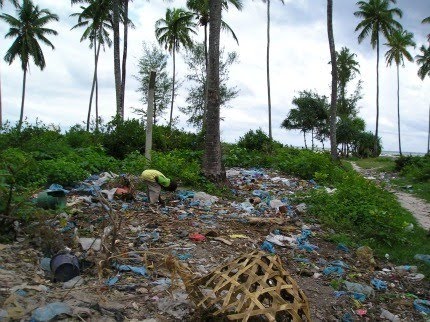
As part of her course work, Brashear went to Zanzibar to do a study on costal ecology in 2006. Zanzibar, an island off the coast of Tanzania, has in recent years become a destination for sun-seeking Europeans. It’s an island of stunning natural beauty, ringed with white sand beaches, crystal clear waters, and trash as far as the eye can see. 'Plastic bags, bottles, cans, batteries, chip bags,' she says. 'The landscape was covered with it.'

In her conversations with local teachers, government officials, hotel owners and ordinary citizens, Brashear came to a devastating realization. In pitching their trash out on the beach, the people of Zanzibar were not engaged in some form of aberrant behavior, nor were they being callous or indifferent to the environment. They were practicing an ancient form of recycling that up until now had worked just fine for them. In traditional Zanzibari culture, a shopping bag, for example, might be woven of grass, an organic material that could be discarded with the certain expectation that the earth would soon reclaim it. Not so with modern materials like plastic bags, which take forever to decompose.

Having brought capitalism to the island, and with it modern materials like plastics, we have, Brashear insists, 'a responsibility to help the people of Zanzibar figure out how to dispose of it.'

Back in Boulder, she spent a year thinking about the problem. Then one day her mother offered a simple suggestion, 'The solution,' she said, 'lies in education.' Mother, Brashear realized, was onto something.

She applied for and received a grant from the CU Undergraduate Research Opportunity Fund to design a curriculum to educate Zanzibaris on how to deal with their trash. While it emphasized reduction of consumption, Brashear’s program also contained some novel suggestions for recycling. Plastic bags, for example, could be cut into strips and crocheted into reusable purses and market bags.

An Italian environmental group active in Zanzibar, the Association of Rural Cooperation in Africa and Latin America (ACRA), was so impressed with her ideas, that they have funded a program to teach them to local school kids. They’re also pushing to have her suggestions included in the national school curriculum.

'To be honest,' she says, 'I still feel disheartened by the amount of trash we generate. I look at people’s grocery carts and see how much packaging it takes to produce just one meal…all that plastic and cardboard. There’s definitely a link to food production. So much of the trash in Zanzibar was food related… juice containers instead of juice from locally grown fruits, for example.'

Brashear is now working with an organization called Grow House in North Denver’s Swansea neighborhood, setting up greenhouses and encouraging area residents to grow their own organic produce. 'I believe,' she says, 'that the solution to the world’s trash problem lies in the localization of food production, and in the individual empowerment of people to control their own food sources.'

Thursday, 11 November 2010

STATEMENT BY THE SECRETARY GENERAL OF THE EAST AFRICAN COMMUNITY, AMB. JUMA V. MWAPACHU


Hotel Diamonds La Gemma de l'Est
Zanzibar, Tanzania

Your Excellency Dr. Jean Ping;
Chairperson of the AU Commission,

Your Excellency Abdoulie Janneh,
UN Deputy Secretary General and
Executive Secretary of the ECA,

Your Excellency Dr. Donald Kaberuka
President of the African Development Bank,

My Colleagues, the CEOs of RECs
and Regional Mechanisms,

Distinguished AUC Commissioners,


Hon. Beatrice Kiraso,
Deputy Secretary General, East African Community,

Distinguished Ladies and Gentlemen.


On behalf of the East African Community, I warmly welcome you to the United Republic of Tanzania and specifically to Zanzibar, the world famous Spice Islands and home to the World Heritage Site of Stone Town. I truly hope that you will not miss the chance to explore the beauty, serenity and splendour of these Islands that are rich in Arabic and Islamic civilization. A special warm welcome to you, Dr. Jean Ping. Your presence at meetings of the AU-RECs Coordination Committee is of great significance. As RECs we feel honoured and respected when you allow us the opportunity to interact with you at close quarters.

We meet in Zanzibar at a most historic moment in the political life of these islands and, indeed, of the Tanzanian Union itself. The Tanzania Presidential and House of Representatives elections which took place exactly eight days ago have opened a new page of democracy, peace and stability for Zanzibar and for the United Republic of Tanzania.

Following the recent constitutional change in Zanzibar to allow the formation of a Government of National Unity as a fundamental political governance principle, Zanzibar has this past week gone through the most peaceful, free and fair elections in history. The political rancour that used to embroil past elections has given way to a political modus vivendi whose driving ethos is the realization of peace, stability and progress for all Zanzibaris.

This new political and constitutional dispensation in Zanzibar augurs well for the consolidation of the Tanzania Union which represents Africa's model of political integration.

Your Excellency and Colleagues,

I believe that all of us have also closely followed the trends in the just ended Tanzania Union general elections. Close observers of the Tanzanian political scene would tell you that the elections this year have reflected a radical departure from those experienced since 1992 when Tanzania re-adopted a multi-party political system government. There has been a marked change in the electoral performance of the political parties, notably of those that oppose the ruling party, CCM.


For true democrats, this change is an important one in the African democratic political process. It shows that democracy and pluralism are taking root and that the electorate is becoming ever more aware of its political rights and choices. Africa needs to share these experiences especially where they reflect powerful trends towards political change but in environments that also manifest strong culture of peace and tranquility.


Your Excellency and Colleagues,

As we meet here today we cannot fail to be seized of the enormity of the mandate of the RECs as the building blocks of the African Union. We cannot also fail to be seized of the complexities of the issues and the serious capacity constraints the RECs face in discharging their mandate. The fact that we have structured this platform is clear recognition of the seriousness we place on our collective quest to share insights and experiences to better deliver on our lofty mandates.
The challenges we face hinge on a number of goals: good governance, peace and security; and social and economic development.

Similarly, there are challenges of a global dimension, such as climate change and unfavorable terms of trade, both of which require joint efforts and effective responses of essentially national but also of regional nature and scope. I am pleased to note that some of these challenges constitute the agenda of our deliberations at this meeting. But I am equally happy that our meeting will focus on how AU's building blocs are working together within the spirit of realizing broader African integration. The COMESA-EAC-SADC Tripartite is a unique model that should be hailed and replicated in other parts of Africa. The view that resides in certain quarters of integration opinion that this tripartite model seeks to undermine the larger continental quest is simply bizarre and impolitic.

Let me end my welcoming remarks by once again thanking the African Union Commission for accepting EAC's wish to host this meeting in Zanzibar. I trust you will find the environment here highly supportive of serious work. As we say in Kiswahili, KARIBUNI SANA.

Tuesday, 9 November 2010

Tanzania listed one of top 10 tourist destinations in 2011


DAR ES SALAAM, Nov. 8 (Xinhua) -- Tanzania has been named as one of the top 10 destinations in the world to visit in 2011 by an Australia-based international travel advisory firm as the east African country has a surprise to offer for tourists who are eager to visit the nation.

Tanzania is a place of great wonders, with national parks such as Serengeti and Kilimanjaro, the Spice Islands of Zanzibar and the famous Ngorongoro crater, said the local media on Monday, quoting a report issued by the Tanzania Tourist Board.

Besides, the country also has big herd of elephants, tree-climbing lions, chimpanzee sanctuaries in Gombe and Mahale and packs of wild dogs in Selous Game Reserve.

The country has the whole panoply of east Africa's wildlife including such rarities as the red colobus monkey, black rhino, hawksbill, leatherback turtles and Pemba flying foxes concentrated in an unrivalled collection of parks and reserves.

Besides Tanzania, Albania, Brazil, Cape Verde, Panama, Bulgaria, Vanuatu, Italy, Syria and Japan are the other top nine countries listed by the travel advisory firm Lonely Planet.

Monday, 1 November 2010

DK ALI MOHAMMED SHEIN - RAIS MTEULE WA ZANZIBAR.


Jumla ya kura zilizopigwa: 364,924

Kura halali:358,815

Kura zilizoharibika:6109

DK ALI MOHAMMED SHEIN :179,809 - 50.1%

MAALIM SEIF SHARIF HAMAD :176,338 - 49.1%

Saturday, 30 October 2010

Who's Who - Election Backgrounder


Tanzanians go to the polls on 31 October to elect their President and Members of Parliament for the next five years. Seven presidential candidates will take part in the polls, including the incumbent Jakaya Kikwete who is running for a second term.

Other candidates are Willibrod Slaa and Ibrahim Lipumba of the main opposition parties, the Chama Cha Demokrasia na Maendelo (CHADEMA) and the Civic United Front (CUF) respectively.

Kikwete is representing Chama Cha Mapinduzi (CCM), which has been in power since independence in 1961.

The Tanzanian parliament, the Bunge is made up of 232 members that are elected while the remainder is appointed. Under the country's Constitution, there are 75 seats guaranteed for women, representing an additional 30 percent of the figure of elected seats.

The 75 women members are appointed by the National Electoral Commission drawn from lists submitted by the parties in parliament, and based on the number of votes won by the parties represented in parliament.

In the last election, CCM won 206 of the elected seats, that is almost 90 percent of the elected seats in parliament. Kikwete won the presidential election with 80.2 percent of the popular vote.

The CUF won 19 seats with the five going to CHADEMA and one each to the Tanzania Labour Party (TLP) and the United Democratic Party (UDP).

The national elections are conducted on the same day as those in the Zanzibar islands, where Zanzibaris vote twice, once for the national President and parliament, and once for their own local President and parliament, which is more like local government.

In the Zanzibar elections, the outcome of the polls will usher in a historic achievement that will see the formation of a unity government, which includes a President from the wining party, first Vice President from the second-placed party and second Vice President from the wining party. Ministries are to be allocated on a proportional basis.

CCM has selected Vice President Ali Mohamed Shein as its candidate for the Zanzibar presidential polls. Shein replaces President Amani Abeid Karume, whose second and final term as Zanzibar President ends in October.

CUF will be represented by Seif Sharif Hamad, who is contesting the polls for the fourth time after failed attempts in 1995, 2000 and 2005.

Zanzibar is a part of the United Republic of Tanzania. However, the Zanzibar archipelago, comprising the two main islands of Unguja and Pemba, retains its own governance structure and electoral system in addition to the Union structures.

Zanzibar and Tanganyika, as the mainland was then known, entered into a Union agreement in 1964 to form the United Republic of Tanzania, whose main objective is to build a unified society based on freedom, human rights and peaceful existence.

The Southern African Development Community (SADC) Election Observer Mission (SEOM) has deployed more than 100 observers to monitor the electoral process in three phases, namely, the pre-election, the election and the post-elections.

SADC Director for Politics, Defence and Security, Tanki Mothae said the pre-election period has been peaceful, adding that the atmosphere should prevail throughout the electoral process.

He said a draft report on how the polls were conducted would be released after the elections. This is in line with the SADC Principles and Guidelines Governing Democratic Elections, which encourages Member States to promote common political values and systems.

The SADC observer team is expected to interact with other regional and international missions such as the African Union and European Union that are in Tanzania at the invitation of the government.

The conduct of the different observer missions will be guided by the Constitution and electoral laws of Tanzania. Foreign Affairs and International Cooperation Minister Bernard Membe has urged observers to adhere to these standards so that the polls are free and fair.

"Observers are expected to be impartial, operate within their mandate and respect the law of the land and authorities responsible for regulating the elections," he said


AllAfrica.com

Thursday, 28 October 2010

Kikwete tipped for re-election


Dar es Salaam - East Africa's largest country prepared for its fourth multi-party polls on Sunday, with President Jakaya Kikwete expected to keep his job despite feistier-than-usual opposition.

Voters will also choose leaders on Tanzania's semi-autonomous Zanzibar island under a new power-sharing system aimed at ending perennial election violence.

Two opinion polls have given Kikwete, 60, a wide margin over his six opponents as he seeks a second and final term in office.

Opposition to his ruling Chama Cha Mapinduzi (CCM - Revolution Party) is at its strongest since the resumption of multiparty politics in 1992 and Kikwete is expected to win with a lower margin than his 80 percent landslide in 2005.

Kikwete, a former foreign minister, has promised to reduce poverty, improve health, education and transport, but his opponents criticised the new pledges, saying poverty is still high despite CCM's rule since 1961 independence.

Tanzania is one of the world's least developed countries, with an economy reliant on non-industrialised agriculture that employs nearly 80 percent of the workforce.

Other economic sectors include mining, construction, manufacturing and tourism Ä for which it boasts the expansive Serengeti park and Kilimanjaro, Africa's tallest mountain, as well as the idyllic Zanzibar archipelago.

The ruling party remained confident it would win the elections, in which some 19 million voters will also elect lawmakers and local leaders.

“We are satisfied with the trend of our campaigns so far,” said Abdulrahman Kinana, CCM's election committee chairman.

“We are going to emerge with a big victory in the presidential, parliamentary and councillors' polls,” he told reporters earlier this month.

One of Kikwete's main opponents is three-time presidential loser Ibrahim Lipumba of the Civic United Front (CUF).

A former University of Dar es Salaam economics professor, Lipumba lost twice to Kikwete's predecessor Benjamin Mkapa in 1995 and 2000 and to Kikwete himself in 2005, and opinion polls have placed him third.

First-time presidential candidate and veteran lawmaker Wilbrod Slaa is Kikwete's closest challenger, but registered a paltry 10

percent in opinion polls released earlier this month.

On the Zanzibar archipelago, a top tourist destination but politically volatile, some 400 000 voters are also called to cast their ballots on Sunday.

CCM's Ali Mohamed Shein, 62, and CUF's 67-year-old Seif Sharif Hamad are the top candidates for Zanzibar's presidency. The two also backed a July referendum to entrench a power-sharing government in the constitution.

Under the new accord, the winning pary takes the presidency while the runners-up are handed the position of vice-president.

Despite a peaceful campaigns, the CUF has voiced concern about the Zanzibar Electoral Commision's (ZEC) transparency.

“We are still concerned about transparency. ZEC has released a copy of voter registers with some irregularities,” the party's poll director Juma Sanani said.

“There are about 10 000 uncollected voters cards which were supposed to be stored by ZEC, but the cards are now in the wrong hands and may be used for double voting.”

Geographically, Zanzibar archipelago comprises three isles, but the third, Mafia, falls under the mainland administratively.

Zanzibar formed a union government in 1964 with mainland Tanganyika, as it was then known, to establish the United Republic of Tanzania.

The CCM has been at the helm since 1977 after replacing a party that ruled the country since independence from Britain in 1961. -

AFP

Monday, 25 October 2010

VOICES II PROJECT SUPPORTS SWAHILI FASHION WEEK 2010


Press conference at RSVP Much More where Co-founder of MTOKO designs discusses with a journalist about their designs for Malaria Hikubaliki being shown at Swahili Fashion Week 2010..


Anna McCartney-Melstad (L), three designers showacasing ideas from Malaria Haikubaliki campaign(Middle) and Fauziyat Abood, during the press conference at RSVP Much More, Dar es Salaam

African, Arab partnership must overcome history of slavery (Feature)


By Anaclet Rwegayura, PANA Correspondent Dar es Salaam, Tanzania (PANA) - When Libyan leader Mouammar Kadhafi recently apologised on behalf of Arab countries that were involved in the African slave trade, some observers regarded his remarks as whimsical, especially because few are wil ling to broach new ideas about the denigration of human dignity engendered by the subjection of Africans to the evils of slave trade.

Many in Africa learnt about slavery as part of history lessons at school, while many have also seen or travelled along the trail of sites, towns, road markers a n d seaports retracing the Arab Slave Trade in Tanzania and in the rest of East Africa. Beyon d that, not much has happened.

According to available studies, more than five million Africans were captured, e nslaved, and shipped to the Middle East, India, Asia, and also to the West.

Today's African population abhors slavery as much as their ancestors did and, as it appears, many will want more than an apology. Analysts have however commende d the Libyan leader for his courage in not only talking openly about the issue but als o apologising on behalf of the Arab countries that were involved in slave trade.

''Though coming belatedly, brother Kadhafi's apology is commendable,'' said Edis on Maige, a retired Tanzanian teacher. ''No Arab leader had shown such courage a n d openness to admit the atrocities that their forefathers committed against the Af rican race.

''Despite the passage of time, hidden grudges are still there in our societies a gainst foreigners who perpetuated slave labour. Accounts of people who had suffe r ed under Arab slavery have been handed down from generation to generation. This explains why local people of Arab descent are sometimes detested, especially when they seek in fluential positions,'' Maige said.

As an outcome of entrenched slavery, Arabs became major planters of coconuts, cloves and other spices in Zanzibar and along East African coastal areas in the 1800s. The crops have since then been the economic mainstay of the islands, though their production no longer booms as they used to be until the 1970s.

Official abolition of slavery in the isles in 1897 did not make a big difference for the majority of the population. The abolition decree by the colonial rulers

and the measures taken to implement it, as it turned out, were designed to bolster Arab slave own ers, to tie ex-slaves to the plantations through contracts and to discourage the independence of workers.

For several years, it became apparent that the number of slaves who were being f reed remained modest and that ex-slaves were restricted from accessing free labour market.

According to records, the end of the slave trade in coastal East Africa, including Zanzibar, came through the gradual destruction of the complex networks that g a thered and distributed slaves.

Zanzibar's clove plantations had survived to enrich Arabs because of slave labour, while slavery itself became an integrated social system under which Africans w ere controlled as personal property.

The changing political landscape of East Africa greatly contributed to the freed om of slaves and reduced their economic dependence on Arab landowners. The expan s ion of British imperial activity increased the demand for caravan porters and Zanzibar became a centre of recruitment.

With Mombasa port in Kenya becoming a staging area for caravans to Uganda and co nstruction of the railway linking the two countries, new demand for workers were
created.

Therefore, slave owners in Zanzibar witnessed a great exodus as slaves escaped t o freedom and new economic opportunities in railway camps.

Although the work in those camps was menial and often dangerous, a slave who deserted his master in the late 1890s could survive in dignity. Wages on the rail road were above the going rate for hired labour on the coast, where economic options for ex-slaves were narrower.

They had no difficulty with the concept of wage labour, but they wanted to contr ol the condition under which they worked, to make cash earnings part of their ec o nomic lives rather than to subordinate themselves to plantation labour. The fertile soils of Zanzibar made it possible for a small plot to produce enough crops for a family ' s subsistence and a surplus for sale.

With a cash income, they could buy all provisions for which they had in the past relied on their owner.

Arab landowners eventually failed to keep ex-slaves as personal dependents tied to their estates and, as the wind of freedom swept across sub-Saharan Africa, th e role of the Arab sultanate and the colonial state in Zanzibar came into question.

By 12 January 1964, the Arab predominance and their ruling structure were topple d by a revolution that gave birth to the present Zanzibar, where all citizens enjoy the social and economic benefits of the state.

Despite the history of slavery involving Arabs, however, the relationship betwee n Africa and the Arab world is not so much represented by the fate of slavery victims.

According to Maige, it is heartening to see African and Arab leaders coming together to put a new life in the relationship of their worlds.

''The basis of our relationship had to change fundamentally. We no longer accept subordination in whatever joint ventures the two sides may agree to undertake,' ' he said.

But Maige warned that African politicians should not use slave trade as an excus e for Africa's underdevelopment.

''Slave trade did not mean the demise of the African race. Renewed partnership w ith the Arab nations should not be a source of disputes with Africa, but it shou l d enable populations on both sides to advance to better standards of living beca u se we all need each other,'' he added.

Friday, 22 October 2010

Commonwealth to Deploy Election Observers


A Commonwealth Observer Group (COG) will be present during Tanzania's General Elections due to be held on 31 October 2010. The COG will be led by former New Zealand Attorney-General, Rt Hon Paul East QC.

The Group was constituted by Commonwealth Secretary-General, Kamalesh Sharma, at the invitation of the National Electoral Commission of Tanzania.

"The Commonwealth has a history of engagement with Tanzania, and we are pleased to observe these important elections," the Secretary-General said. He went on, "We very much hope that they will further strengthen the democratic process and advance development in the country."

The Group's mandate is to observe the preparations for the election, the polling, the counting and the results process, and the overall electoral environment. The team will be there to assess the conduct of the process as a whole and, where appropriate, make recommendations for the future strengthening of the electoral framework in Tanzania, including the process in Zanzibar.

The Group will act impartially and independently, and will conduct itself according to the standards expressed in the International Declaration of Principles for Election Observation, to which the Commonwealth is a signatory.

The Group's report will be submitted to the Commonwealth Secretary-General, who will in turn send it to the Government of Tanzania as well as to the authorities in Zanzibar, the National Electoral Commission, the Zanzibar Electoral Commission and political parties, and eventually to all Commonwealth Governments.

The Commonwealth Observer Group is expected to comprise 15 experienced persons, including the Chair. The team will arrive in Tanzania on 24 October 2010, and stay until 7 November 2010.

Commonwealth Observer Group - Tanzania 2010

Chair: Rt Hon Mr Paul East, QC, Former Attorney-General, New Zealand

Mrs Judy Hopwood MP, Member of Parliament, Australia

Ms Juliette Maughan, Youth Representative, Barbados

Mr Pierre Paul Martin, Elections Expert, Canada

Hon Omar Jallow, Politician, Gambia

Mrs Pauline Dadzawa, Election Commissioner, Ghana

Dr Rupert Roopnaraine, Politician, Guyana

Mr Akshay Rout, Director General, Election Commission, India

Ms Jane Godia, Media/Gender Expert, Kenya

Ms Cheryl Dorall, Media Consultant, Malaysia

Sheikh (Dr) Abdul Karimo, Co-ordinator, Elections Obsevatory, Mozambique

Mr Charles Munyaneza, Executive Secretary, National Election Commission, Rwanda

Mr Pesi Fonua, Publisher/Editor, Tonga

Hon Irene Ovonji-Odida, Former Member of the East African Legislative Assembly, Uganda

Mr Frank Martin, Former Diplomat, United Kingdom


AllAfrica.com

Wednesday, 20 October 2010

THIRD SWAHILI FASHION WEEK OFFICIALLY LAUNCHED....


From Left to Right Alex Galinoma from EATV & Radio, Saphia PR & Media SFW, Mustafa Hassanali organiser of SFW, Judith Muya of Southern Sun -Home of SFW and Washington Fashion Coordinator, during the 3rd SFW Launch.

24 DESIGNERS TO SHOWCASE OVER A PERIOD OF 3 DAYS

LAUNCH OF THE FIRST EVER SWAHILI FASHION WEEK SHOPPING FESTIVAL

The third annual Swahili Fashion Week will take place at Karimjee Gardens on the 4th, 5th and 6th November 2010 in Dar Es Salaam, Tanzania.

Swahili Fashion Week 2010 will collectively bring together 24 designers from Swahili speaking countries to showcase their creativity in designing a variety of clothing with an assortment of materials.

The Tanzanian designers showcasing at this years event are Ailinda Sawe, Manju Msita, Kemi Kalikawe, Christine Mhando, Shellina Ibrahim, Farha Naaz Sultan, Gabriel Mollel, Robi Morro, Asia Idarous, Zamda George, Khadija Mwanamboka, Jamilla Vera Swai and Made by Africa. Designers from Kenya to showcase are Sonu Sharma, Moo Cow, KikoRomeo, John Kaveke and Kooroo. Stella Atal from Uganda will also show her designs.

“In addition to the Fashion Show presentations, this year Swahili Fashion Week has incorporated Swahili Fashion Week Shopping Festival which will capture the spirit, style and essence of the Swahili coast” said Mustafa Hassanali, organiser of the event.

“Opening Swahili Fashion Week to a new audience, the Shopping Festival will showcase not only traditional Swahili arts and culture but the inspired innovation, and dynamic creativity of the modern Swahili speaking world, offering stalls to all participating fashion designers to exhibit and sell their unique, often hand-made clothing, accessories and products. Stall priority to those not on the runway will be given to artists, crafts-people, etc who are disabled or underprivileged”, added Hassanali.

Throughout the exhibition, there will be a variety of entertainment including performances from different music groups, henna painting and adornment and weaving. There will also be a choice of workshops for designers to participate in.

Swahili Fashion Week has organized several awards in order to recognise the prospective talent showcasing, these include the Emerging Designer Award, Best Runway Model and Best Swahili Fashion Week Shopping Festival stand.

Swahili fashion week 2010 has been sponsored by the home of Swahili Fashion Week - Southern Sun, Origin Africa, USAID Compete, EATV, East Africa Radio, Malaria Haikubaliki, BASATA (Baraza La Sanaa Taifa), Ultimate Security, Monier 2000, Colour Print Ltd, Global Outdoor Ltd, Amarula, Vayle Springs Ltd, ZG Films, Darling Hair, Danish make up designs, Nipashe, Bilicanas, Perfect Machinery Ltd, 1&1 Internet Solutions, Sengi Tours, iFashion and 361 Degrees.

NOTE TO EDITORS

Swahili Fashion week is a platform for designers – both fashion and accessory – from Swahili speaking countries to showcase their creativity, market their art and network with their clientele. This is all aimed at promoting fashion as an income generating, job creating industry while emphasizing a “Made in East Africa” concept.

Swahili Fashion Week is set to be an annual fashion extravaganza showcasing the best of creative talent in the fashion from Swahili Speaking countries. This being the regions highly acclaimed premier Fashion event founded created and conceptualised in year 2008 by Mustafa Hassanali

“Initiating a dynamic and promising platform for the fashion industry in the region, Swahili Fashion Week is geared towards being the most sought out fashion platform in Eastern Africa for the international market”, explained Mustafa Hassanali, founder and organizer of Swahili Fashion Week.


FOR IMMEDIATE RELEASE


CONTACT PERSON: Saphia Ngalapi, Media & PR Manager
TELEPHONE NUMBER: +255-712-099834
EMAIL ADDRESS: media@swahilifashionweek.com

Saturday, 16 October 2010

Judge Releases Full Ruling That Blocked Terror Trial Witness


Southern District of New York Judge Lewis A. Kaplan on Thursday released his full opinion on the credibility of a critical witness he blocked from testifying at the trial of accused al-Qaida conspirator and U.S. Embassy bomber Ahmed Khalfan Ghailani.

In his 60-page opinion elaborating on his Oct. 6 three-page public order barring Hussein Abebe from the witness stand, Kaplan called Abebe's testimony "false" and "quite incredible" on the key issue of whether he was coerced into testifying by threat of prosecution either in New York or in Tanzania.

The judge also offered a more expansive review of the law concerning Abebe, a Tanzanian who allegedly sold the explosives to Ghailani used in the truck bomb detonated outside the U.S. Embassy in Dar es Salaam, Tanzania, on Aug. 7, 1998, 10 minutes after a similar bomb destroyed the embassy in Nairobi, Kenya. In all, 224 people, including 12 Americans, were killed and more than 4,000 were wounded.

The law in this matter was the Fifth Amendment, and the issue was whether Ghailani's right to be free from self-incrimination was violated because the identity and whereabouts of Mr. Abebe were "allegedly extracted by physical and psychological abuse of" Ghailani in a secret CIA prison.

Abebe, who one FBI agent testified "feared the knock at the door" after seeing Ghailani's face on Tanzanian television just after the bombings, was picked up in August 2006 and detained for 11 days.

He was first questioned by Tanzanian authorities and then visited by an FBI team that secured his promise to testify against Ghailani. The last four days of his detention were spent in lockup in Dar es Salaam. He was ultimately released on a bond describing him as having been "accused of committing the offense of conspiring to murder and terrorist acts."

That bond was eliminated over a year later after Abebe's brother-in-law, the chief judge of the Supreme Court of Tanzania, intervened on his behalf.

Abebe, who insists he is willing to testify voluntarily, flew to New York in August.

He was questioned in a two-day hearing before Kaplan in September, and the judge indicated then that his story did not add up. On Thursday, he made that even clearer.

"Abebe testified that he knew he was in trouble by the time he got to Zanzibar, but that he had no idea why he had been arrested until he was asked about the 1998 bombings in Zanzibar two days later," Kaplan wrote in his opinion. "This is quite incredible. Abebe had lived in fear of this arrest for years and understood from the moment he arrived at the police office in Arusha that the arrest related to the embassy bombings. He was very frightened."

The full opinion, the first extended analysis of the consequences of finding a witness through so-called "enhanced interrogation techniques," was released to the public Thursday after being vetted by a court security officer.

But the full opinion was delivered to lawyers on Oct. 6, giving the prosecution team led by Michael Farbiarz only a few days to decide whether to make an appeal as of right or finish jury selection and start Ghailani's trial.

The prosecution elected to proceed to a trial that Thursday completed its third day of testimony.

While the government's decision avoided a lengthy delay and the attendant risk that the 2nd U.S. Circuit Court of Appeals might make new law on "poisonous fruit" derived from illegal CIA interrogations of terror suspects, it also left Kaplan's opinion standing, giving it more force as precedent.

The prosecution has sought to avoid a head-on collision with judges over the consequences of the government's detention and interrogation program, a move that might isolate the law made here to the facts presented in Ghailani's case.

To that end, and no doubt for other reasons of strategy, the prosecution has vowed not to Ghailani's statements to the CIA and have admitted that he was abused only for purposes of the argument.

The judge's Oct. 6 decision prompted Ghailani defense lawyer Peter E. Quijano to claim a victory for the Fifth Amendment, telling the media, "This case will be tried upon lawfully obtained evidence only. Not coercion. Not torture."

The trial is being closely watched by people on all sides of the debate over whether terror suspects should be tried in civilian courts or whether trial by military commission is the better route. Ghailani is the first Guantanamo Bay detainee to be tried in civilian court.

The judge alluded to this controversy in footnotes in his opinion, United States v. Ghailani, S10 98 Crim. 1023.

"It is very far from clear that Abebe's testimony would be admissible if Ghailani were being tried by military commission, even without regard to the question whether the Fifth Amendment would invalidate any more forgiving provisions of the rules of evidence otherwise applicable in such a proceeding," the judge said.

Military Commissions Act §948r(a) and the Military Commission Rules of Evidence, Rule 304, he said, "preclude or restrict the use of 'statements obtained by torture or cruel, inhuman or degrading treatment,' and evidence derived therefrom, and could require exclusion of Abebe's testimony."

He added, "Even if they did not, the Constitution might do so, even in a military commission proceeding."

The judge in his opinion said Abebe's decision to testify in New York was not "a free and unconstrained" one.

"He quite plainly is no eager volunteer," the judge said. "He never would have come forward on his own. He is 'willing' to testify now only because he fears that things will go badly for him if he does not."

The judge also found hard to believe Abebe's statement at the hearing that he was coming forward to "cleanse" his heart and soul.

"If indeed Abebe's heart were moved by his having supplied the explosives that killed hundreds and wounded thousands of people, it would be very difficult to understand why he did not come forward on his own," the judge said. "The need for cleansing his heart and soul was at least as strong over the eight years before his arrest as it has been since."

The judge also explored further the distinction between the "deterrence analysis" of suppression under the Fourth and Fifth amendments, saying, "As this is a Fifth Amendment case, the receipt in evidence of Abebe's testimony itself would constitute a violation of the self-executing exclusionary rule inherent in the Constitution, not a matter of compliance with a purely utilitarian judge-made rule that was created in the twentieth century only to deter illegal searches and seizures."

He continued, "The CIA, acting upon the highest authority, used coercive methods to gain intelligence. This court has declined to this point to express an opinion on the constitutionality of such methods, considered in and of themselves. It declines to do so now because that issue is not before it.

"What is before it, however, is the question of whether the Fifth Amendment -- which provides that 'no person … shall be compelled in any criminal case to be a witness against himself' -- is violated if a court receives in a criminal case evidence that is the fruit of statements coerced from the defendant, at least where the relationship between the coerced statements and the evidence is as close as it is here."


Law.com

Thursday, 7 October 2010

Ahmed Khalfan Ghailani profile


Ahmed Khalfan Ghailani is accused of involvement in the US embassy bombings in Tanzania and Kenya in 1998, which killed more than 200 people.

Mr Ghailani, a Tanzanian, was arrested in Pakistan in July 2004 and handed over to the US at the beginning of 2005.

He was one of 14 detainees transferred in September 2006 from secret CIA prisons abroad to the Guantanamo Bay prison camp in Cuba.

And he is the first former Guantanamo Bay detainee to go on trial in a civilian court in the US.

He pleaded not guilty in June 2009 to charges of conspiring to commit the embassy bombings. If found guilty, he could face the death penalty.

According to a transcript of a closed-door hearing in March 2007, Mr Ghailani admitted delivering explosives used to blow up the US embassy in Tanzania in 1998.

However, he said he did not know about the attack beforehand and apologised to the US government and the victims' families, the transcript said.

'Scouting the embassy'
A short, squat man, Mr Ghailani is said to have had dozens of aliases, including "Foopie" and "Ahmed the Tanzanian".


The bombings in Tanzania and Kenya were almost simultaneous
He is thought to have been born on the Tanzanian island of Zanzibar in 1970 or 1974, making him 40 or 36 years old, and is said to speak fluent Swahili and English.

He was number eight on the FBI's most wanted list - his baby-faced photograph belying the severity of the charges on which he was indicted by New York authorities in 1998.

The Tanzanian national is accused of buying the truck that carried the bomb used in the Dar es Salaam attack.

He and his accomplices are also accused of buying oxygen and acetylene tanks used to enhance the force of the explosion.

He is also said to have escorted the bomb maker between Dar es Salaam and the Kenyan city of Mombasa after the bomb was made as well as scouting the US embassy with the suicide bomb driver.

The near-simultaneous bombings in August 1998 killed 213 people in Nairobi and 11 people in Dar es Salaam as well as injuring thousands more. Twelve Americans were among the dead.

Big bounty
Analysts described Mr Ghailani as a very important figure, who was probably sent to East Africa at the time of the bombings by Osama Bin Laden's second-in-command, Ayman al-Zawahiri.

It is suggested that Mr Ghailani fled to Afghanistan after being indicted in 1998.

According to the US transcript, he admitted visiting an al-Qaeda training camp in Afghanistan after the bombings. But he denied being a member of al-Qaeda.

Mr Ghailani was reported to have been in the Liberian capital, Monrovia, in 2001, with another suspect in the embassy bombings, a Kenyan man Fazul Abdullah Mohammed.

The UK's Observer newspaper reported in 2002 that the two men allegedly ran a lucrative al-Qaeda financing operation, trading illegal "blood diamonds" for cash.

The paper said the operation ran into trouble in June 2001, when reports reached al-Qaeda that Mr Ghailani and Mr Mohammed were lavishing money on women, presents and alcohol.

In May 2003, the FBI named Mr Ghailani on a list of seven people it suspected of concocting a fresh al-Qaeda plot, and increased the bounty on his head to $5m.

On 25 July 2004, he was arrested in Pakistan along with his Uzbek wife.

Pakistani officials at the time said Mr Ghailani's arrest was the most significant since the detention in March 2003 of Khalid Sheikh Mohammed, the suspected mastermind of the 11 September attacks on the US.

BBC

Tuesday, 5 October 2010

Tanzania: The Use of Social Media in 2010 Tanzania General Election

Tanzania will go to the polls on October 30, 2010 and the general election campaign is well underway. As the campaigns heat up, presidential candidates and other candidates fighting for parliamentary seats are using new media tools to communicate with potential voters. Along with campaign rallies, which target the majority of the population, a small number of politicians have started to use social media tools such as blogs, online videos, Facebook and twitter to create deeper engagement with voters.

It is hard to accurately comment on the impact of the ongoing online campaigns because of lack of up-to-date statistics on usage of social media tools in Tanzania. The number of Tanzanians using the Internet is still small in comparison to the total population. In a country of 41 million people there are only 676,000 Internet users representing 1.6% of the total population. Among those with access to the internet there are only 141,580 Facebook users, with 74% of them aged between 18-34 years.

Whether created by fans or formal campaign officials, there are a few websites, blogs, facebook pages and twitter accounts running campaigns for presidential candidates and those fighting for parliamentary seats from the ruling CCM party. The official website of the current president and the ruling CCM party candidate, Jakaya Mrisho Kikwete, has a link to a facebook page with more than 4,500 followers. There is also another facebook page dedicated to Mr Kikwete with more than 13,500 fans.

Kikwete’s running mate who is also the candidate for the Vice President's post, Dr. Gharib Bilal, has more than one campaign websites. One site is linked to Mr Kikwete’s website and Dr. Bilal’s twitter account, while the other website has a link to a facebook page dedicated to his campaign.

One of the opposition parties presidential candidates Dr. Wilbrod Slaa from CHADEMA party has a facebook page linked from his official website with about 910 fans. Likewise there are more than two facebook pages dedicated to Dr. Slaa’s campaign with about 9000 people who ‘like’ Dr. Slaa. He also has a twitter account with very few tweets.

Similar to Tanzania Mainland, election manifestos, pictures and videos of the campaign rallies are on display on the websites of the Zanzibar’s CCM presidential candidate Dr Ali Mohamed Shein as well as on his main opposition contender Maalim Seif Sharif Hamad from the Civic United Front (CUF).

Announced mostly through twitter and blogs, online campaign videos with clips from election rallies have so far received a little more than 12,000 views in total at the time of writing this post. Some of the videos appear to have been uploaded directly from the rallies, like this one from CHADEMA’s Kigoma North candidate, Hon. Zitto Kabwe

More details click here

Thursday, 30 September 2010

Chombo cha Ushahidi


Vijana FM inatumia Crowdmap, chombo kilichotengenezwa na Ushahidi, kukusanya taarifa, mawazo na uzoefu wakati wa Uchaguzi Mkuu Tanzania. Ni matarajio yetu kwamba chombo hiki kitawapa jukwaa watu kutoa taarifa, maoni, kuanzisha mijadala na kueneza ujuzi wa mchakato wa uchaguzi na matukio mbalimbali.

Taarifa zinaweza kuwasilishwa kwa njia tatu:

1. Kwa kutuma barua pepe: TZelect (at) gmail (dot) com

2. Kwa Twitter hashtags #TZelect au #uchaguzitz (Shukrani Jamii Forums)

3. Kwa kujaza fomu kwenye tovuti

Saturday, 25 September 2010

11 NORWEGIAN MPS IN TANZANIA TO LEARN ABOUT DECENT WORK


A group of 11 Norwegian parliamentarians is visiting Tanzania 22-26 September. Their aim is to learn about Tanzanian strategies to promote decent work in the country, and the mission is part of Norway's efforts to promote workers' rights on a global level.

The International Labour Organisation (ILO) is responsible for coordinating the MP programme, which includes a visit to project sites in both Moshi and Zanzibar. The programme in Dar es Salaam involves a meeting with Minister for Labour Hon. Prof. Juma Athumani Kapuya as well as representatives from The Association of Tanzania Employers (ATE) and Trade Union Congress of Tanzania (TUCTA).

In 2008 Norway as one of the first countries in the world adopted a strategy for promoting Decent Work including safeguarding workers' rights on a global level. The partnership with ILO is key to implementing this strategy.

- I am very pleased to welcome the MPs to Tanzania. Their visit is a signal of the important and longstanding partnership between our two countries. The focus of the mission is also crucial, as decent work is central to people's lives, says Ambassador designate Ingunn Klepsvik.

The group of 11 parliamentarians has members from 5 different Norwegian political parties. They are all members of The Standing Committee on Labour and Social Affairs in the Norwegian Parliament. 6 of the parliamentarians represent the coalition government in Norway, while 5 come from the opposition parties. The visit to Tanzania is part of a mission to Ethiopia, Tanzania and South Africa.

Friday, 24 September 2010

Zanzibar's island idyll under threat....


Travel down the east coast of Zanzibar on board an Arab dhow, and the spice island seems not to have changed for centuries. A row of white surf, open sand and coconut palms marks the shoreline.

For miles, there is no intrusion from anything man-made, save for the triangular white sails of other dhows, so graceful and slender that they seem entirely as nature intended.

From time to time, the thatched, conical roofs of a handful of relatively small hotels appear among the palm trees. But the Indian Ocean's turquoise waters still lap a largely undeveloped coast.

This may not be true for much longer. Prodded by the central authorities in Tanzania, Zanzibar's semi-autonomous government is promoting the development of big hotels along the eastern shore.

The idea is to change the focus of the island's tourism. At present, Zanzibar benefits from a high-value, low-volume model where most visitors come to the spice island after a safari in Tanzania's national parks. They stay for an average of five nights in a few, comparatively small hotels, often directly overlooking the sea.

But Amani Abeid Karume, the president of Zanzibar, wants to change this. The idea is to make Zanzibar a mass destination in its own right – independent of "bush and beach" visitors who go on safari first. This means lower prices, more hotel beds, more tourists and, perhaps inevitably, an end to the undeveloped beauty of the east coast.

"Sadly, the government of Zanzibar has this idea that they have to be like Kenya and Mauritius and they need big investors to build big hotels," says one local operator. "Zanzibar might end up being a cheap destination for mass tourism."

If so, small retreats, like Ras Nungwi Beach Hotel on the island's northern peninsula, will become rare exceptions. Set on a perfect tropical beach, where the afternoon tide brings turquoise water lapping against honeycombed rocks and white sand, Ras Nungwi has only 32 rooms.

Most are found in thatched rondavels, often directly overlooking the ocean. Ras Nungwi was built before a new regulation came into force, specifying that all hotel rooms must be at least 250ft from the high-tide mark.

If you stay in the Ocean Suite, you will have a small beach to yourself, complete with your own two-storey house with more than 2,000 sq ft of living space.

Elsewhere in Zanzibar, seaweed and cloudy waters can make the beach disappointing. At Ras Nungwi, however, the sand could scarcely be finer nor the water clearer.
"There is a big turnaround of oceanic currents here, which gives us our clear water," explains Chris Goodwin, the general manager.

If Zanzibar eventually succumbs to the mass tourism model, small and intimate havens such as Ras Nungwi will become rarer.


Telegraph

Tuesday, 21 September 2010

Tawi la CCM Chokocho


Tawi la CCM Chokocho Pemba, katika uzinduzi wa kampeni za CCM Pemba mapema wiki hii.

Tanzanian ruling party presidential candidate for Zanzibar launches campaign


Tanzania's ruling revolutionary party of Chama Cha Mapinduzi (CCM) presidential candidate for Zanzibar Ali Mohamed Shein has launched the party's election campaigns in the Indian Ocean archipelago with a commitment for agriculture development through use of modern farming technology and maximum use of irrigation.

At a registered turn up record on Saturday in Zanzibar, Shein noted that his government would maintain good governance, noting that CCM is in a position to apply good governance in its leadership, the local newspaper Daily News reported on Sunday.

He said that he would uphold and implement CCM's manifesto and policies and that he would sustain two-government structure of the Union government and Zanzibar government, opposing the Civic United Front (CUF)'s three-tier government.

The CCM's policy has always upheld two governments for the past 46 years and he will continue to uphold this in order to protect the Union for the public benefit, said Shein.

With the attendance of CCM high level officials, from Tanzania mainland and Zanzibar, the campaign rally were preceded by songs, dancing and reading of poems and Shein also promised to continue bringing development to the Isles if voted to leadership.

In Zanzibar, 66.4 percent people in Tanzania's Indian Ocean archipelago of Zanzibar voted in favor of the formation of government of national unity after the amendment of the constitution in July, indicating that rivalry witnessed in the previous elections since 1995 will be unlikely after the election this year.

Under the proposed structure of a government of national unity likely to be formed after the next elections, if Shein wins the presidential election in Zanzibar, CUF's Seif Sharif Hamad would become First Vice-president of Zanzibar, and the second vice president would come from CCM.

Tanzania is considered Africa's most politically stable country, where the ruling party CCM has been in power for the past 49 years and there have been four successive transfers of power.

The local, legislative and presidential polls on Oct. 31 are the country's fourth since the re-introduction of multi-party politics in 1992 in the east African country with the current population of more than 40 million.


Xinhua

Saturday, 18 September 2010

Dr. Shein na tovuti yake


Tovuti rasmi ya Mgombea urais kwa tiketi ya CCM Zanzibar ipo hewani sasa... Tembelea hapa